
Royal Oak City Directory Collections
The Royal Oak Public Library Local History Room finding aid identifies the actual directory shelf runs for Royal Oak. Its detailed year list is more useful than a broad coverage claim because it shows where gaps occur. The shelf begins with a Village Directory from before city incorporation, continues through selected Polk volumes, and later adds South Oakland Bresser cross-indexes. These city directories are historical listings. They can establish that a person, household, subscriber, or business appeared in a printed source in a given year, but they do not prove ownership, every person in a home, or a family relationship.
| Royal Oak collection | Years held | Where held | Access |
|---|---|---|---|
| Royal Oak Village Directory | 1915–1916 | Royal Oak Public Library Local History Room | Reserve the room; collection use is in library |
| Polk Royal Oak city directories | 1924, 1926, 1928, 1930, 1933, 1936, 1938, 1940, 1942, 1945, 1948, 1953, 1955, 1956, 1958, 1960 | Royal Oak Public Library Local History Room | Physical historical collection |
| Polk South Oakland | 1997–1998 | Royal Oak Public Library Local History Room | Physical historical collection |
| Bresser South Oakland cross-index | 1952–1955; 1964–2013 | Royal Oak Public Library Local History Room | Physical historical collection |
| Royal Oak telephone directories | 1931, 1941, 1956, 1989–1991, 1995–1997, 2002, 2004, 2006, 2007, 2010–2011 | Royal Oak Public Library Local History Room | Physical historical collection |
The library also holds an Oakland County telephone directory from 1924. The Local History page describes the Polk Royal Oak run as 1922–1960, while the finding aid supplies the individual volumes listed above. Treat the individual list as the precise shelf inventory. A missing year means only that it is not listed in the finding aid, not that no directory was published or that a person was absent.
Royal Oak's Earliest Directory Years
Royal Oak began as a township in 1819, became a village in 1891, and became a city in 1921. That change explains why the 1915–1916 Village Directory belongs at the start of a Royal Oak city directory search even though its title does not say city. The Local History Room also has a Village Treasurer log for 1919–1920, City Commission minutes from 1912–1913, and tax rolls that begin as early as 1845. They help place a name before the city-era printed series.
The Royal Oak Public Library genealogy resources complement those shelves with Ancestry Library Edition, HeritageHub, Michiganology, and MyHeritage access. The library lists Ancestry Library Edition as an in-library resource. Use a directory name as a search lead, then compare the printed year and location against the database result rather than treating a match as the same person automatically.
Royal Oak Public Library genealogy resources provide the source context for this Royal Oak city directory collection.

Reservation is required for the Local History Room; Adult Reference can be reached at 248-246-3727 for collection help. Many of the volumes are used in the library, so checking access before a visit avoids relying on a title that cannot be viewed from home.
Reading Royal Oak City Directory Entries
A Royal Oak city directory entry should be read as a dated printed statement, not as a full profile. The official finding aid does not reproduce a sample entry for every run. It does say entries may combine a person or household name, an occupation or employer, an address, and telephone information depending on the year. Copy the text as printed, including initials and spelling, because a later search may use a different form of the same name.
| Listed name | The person, household, subscriber, or business printed in that volume. Initials can be important for separating similar names. |
|---|---|
| Address | A dated street address when the volume includes one. It is a lead for maps, deeds, and adjacent directory years, not proof of current residence. |
| Work detail | An occupation, trade, or employer when printed. Its presence and wording vary by volume. |
| Telephone detail | A listed number when included. It reflects a subscriber or listing, so unlisted numbers and other people at the address may be absent. |
| Year and volume | The exact date, publisher, and page needed to retrace the result in the physical collection. |
- Criss-cross directory
- A reverse or address-oriented directory. In the Bresser South Oakland run, begin with a known house number and street, then compare the listed name with the ordinary alphabetical section.
- Householder index
- An index arranged around a household or address rather than a complete census. It can point to a printed listing without proving every member of the home.
- Abbreviation key
- The explanation printed in a particular volume for its shortened labels. Check that volume's key before expanding a mark, because the official finding aid does not establish one universal Royal Oak code system.
Note: A directory's entry pattern varies by publisher and year, so inspect the page and its abbreviation key before drawing a conclusion from a short mark.
Royal Oak Yearbooks and Tribune
Yearbooks and newspapers are useful companions when city directories leave a gap. The Local History Room lists Royal Oak High School yearbooks for 1920–1927, 1929–1931, and 1934–1957; Dondero for 1956–1985, 1987–1997, 1999–2003, and 2006; Kimball for 1958–2006; and Royal Oak High School for 2007–2013 and 2015–2022. It also lists Oak Ridge for 1926–1927; St. Mary for 1929–1930, 1964, 1968–1970, and 1973; Shrine for 1962–1963 and 1973; middle school for 2016; and Oak Ridge Elementary for 2021. An alumni listing can connect a person to a school and year, but it does not establish a home address.
The library's Royal Oak Daily Tribune digital archive can be searched by name, subject, or keyword, and can be browsed by date or page layout. Local History Room clippings add Royal Oak people, homes, organizations, and events. The library materials give two different end dates for the digital Tribune archive, September 2019 on one page and December 2019 on another. Confirm the live archive's endpoint before quoting a final date range.
Telephone books add another dated clue. Their listed landlines and business entries can omit unlisted numbers, children, and people without subscriptions. A phone listing therefore supports only the narrow claim that someone used the printed listing at that time. HeritageHub also supplies obituary and funeral notices, but its stated broad database coverage is not proof that every Royal Oak notice or year is present.
Royal Oak Maps and Archives
When an older city directory address does not match a current street label, use the map record before assuming the entry is wrong. The Local History finding aid lists an annexation map, street maps for 1927, 1955, and 1964, and cemetery maps. The Library of Congress has a January 1926 Royal Oak Sanborn map set with 37 public-domain images. Together, those materials can show a building footprint, street context, or a changed neighborhood pattern. The research did not locate a complete official renumbering or street-renaming table, so a date for a citywide change should not be invented.
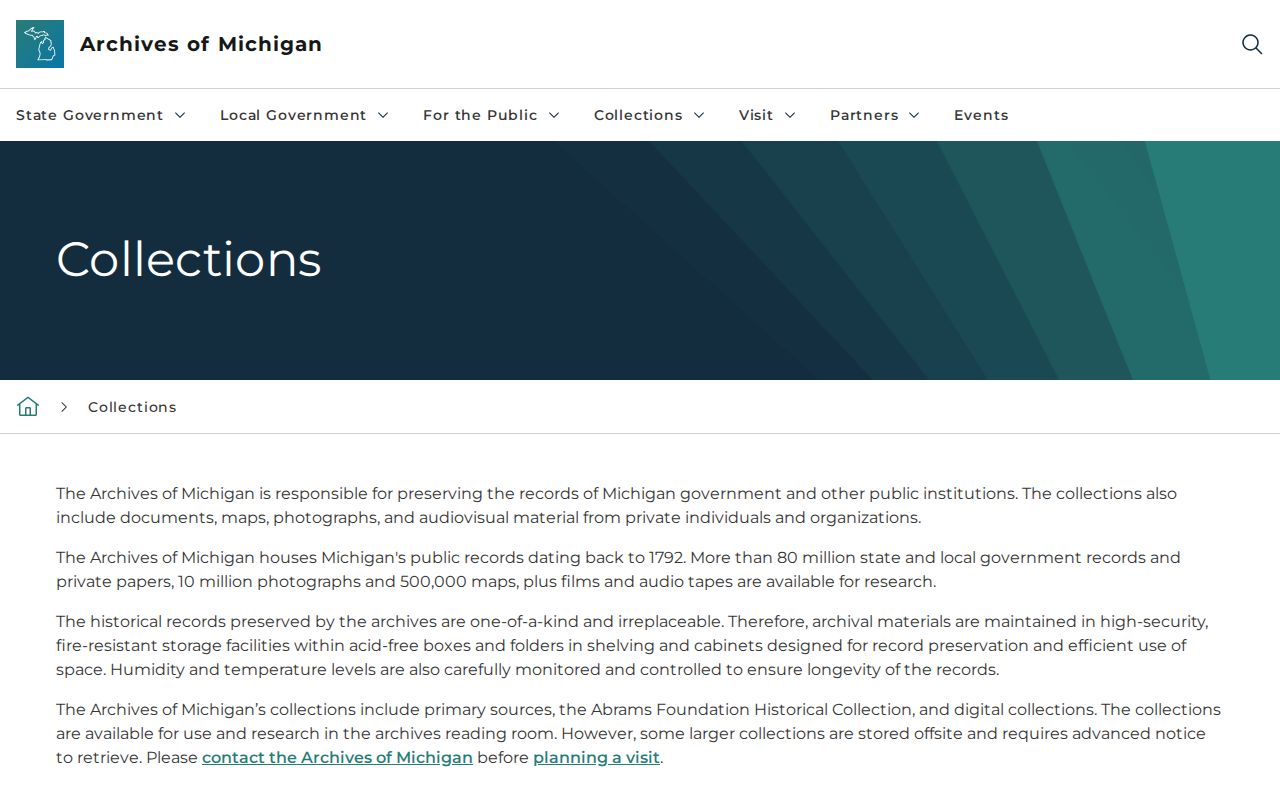
Archives of Michigan collections extend the trail beyond the local shelves with state and local records, naturalization files, court and probate material, census resources, military records, and maps. The Oakland County guide specifically identifies Royal Oak Township voter books for 1928–1932 and older tax, probate, and naturalization series. These are collection leads with different access methods, not one unified name search.
Archives of Michigan collections show the broader record groups that can support a Royal Oak city directory result.
For an address that has changed, retain the old printed form, compare nearby streets on the historical map, and preserve the parcel's legal description when one is available. That is stronger than forcing an older directory address into a modern label.
Tracing Royal Oak City Directory Households
A useful household trail follows the printed record forward and backward in time. Bresser South Oakland is the address-first bridge because its cross-index can be approached from a known street address. Polk volumes add alphabetical name checking. If a surname changes at an address, record each year and printed form. Do not assume the names are related, and do not convert an occupant listing into an ownership claim.
- Start with a dated address or name from a deed, obituary, map, or family paper. Write down the street form exactly as it appears.
- Check the Bresser South Oakland cross-index for that house number and street, then check spelling variants and nearby years.
- Read the alphabetical Polk section for the same name and compare the adjacent available volume. The Royal Oak Polk gaps are part of the collection record.
- Pair the listing with a yearbook, Daily Tribune notice, voter record, or probate and death record that independently matches the date or family connection.
- Confirm a property timeline through Oakland County deed and tract records when the question is about title. A listed directory occupant and a recorded deed party can be different people.
For a former household, this sequence creates a dated chain rather than a guess based on one name. A person who disappears from a volume may have moved, died, changed a listing, become unlisted, or simply fall in a year the library does not hold. The most defensible result says what the cited volume shows and identifies the next independent record to check. For an address-focused chain after the printed period, use the Previous Residents records path.
Royal Oak City Directory Limits
City directories are not census rolls. Bresser may identify a listed occupant, subscriber, household, or business at an address, while Polk may list a person alphabetically with details that change by year. Telephone directories can omit unlisted numbers. A school yearbook links a person to a school year, not necessarily a residence. A map can explain an address, but does not name a household. Each source answers a smaller question.
Local History Room material also includes property abstracts, voter registrations from 1894–1928, and tax-assessment rolls for 1845, 1849, 1851, 1854–1855, 1857–1859, 1862–1864, 1866–1867, 1873, 1879, 1881, 1898–1899, 1901, 1903, and 1908. Those holdings are physical or collection-based leads, not a promise of an online resident list. Preserve source, date, page, and uncertainty with every historical finding.
Note: A direct question to Adult Reference is the practical fallback when a needed year is missing, a volume is not digitized, or an older street form needs local context.