
Finding Royal Oak Resident Records
Royal Oak has no single official list of everyone in town. The useful record depends on the question. An address can lead to a parcel and its recorded owner through City of Royal Oak Assessing. A recorded transfer can be followed through Oakland County land records. A past household is often easier to place in a printed directory, telephone book, yearbook, or newspaper held by the Royal Oak Public Library. Court, voter, and vital systems are narrower. They can confirm an event or public case trail, but they do not make a complete residents directory.
Keep the kind of address straight as you search. A parcel’s situs address is the land itself. An owner mailing address is where tax correspondence goes. A directory entry is evidence that a person or subscriber was listed in that year. None of those fields alone proves that every person at a property lives there now. Two dated, independent records are a much safer basis for a Royal Oak residents directory search.
- For a street address, search Royal Oak BS&A by address, owner name, or parcel number and record the displayed parcel key.
- For a documented ownership trail, search the Oakland County Super Index by name, address, or PIN and note the recorded date and document number.
- For a person, compare public court or voter channels only within their rules and match middle initials, dates, and party roles.
- For an earlier household, reserve the Local History Room and check Polk, Bresser, telephone, and newspaper material for the matching year.
- When an online result is missing, ask the actual custodian for an existing record by a precise address, date range, and record type under Michigan FOIA where appropriate.
Note: A blank result can reflect a privacy rule, an older paper record, a name variant, or a source that was never designed as a household list.
Royal Oak Resident Record Custodians
Royal Oak records are divided among city, county, state, and library custodians. City Assessing maintains the local assessment roll and BS&A property route. Oakland County Clerk/Register of Deeds keeps recorded land instruments and the Super Index. The Royal Oak Clerk handles city elections, municipal records, and FOIA routing. State systems hold voter, vital, and statewide court material. The county seat is Pontiac, not Royal Oak, so a county land or vital request goes to the Oakland office even when the event or parcel is in Royal Oak.
Oakland County Clerk/Register of Deeds
1200 N Telegraph Road, Department 480
Pontiac, MI 48341
248-858-0606
City of Royal Oak Assessing
203 S Troy Street
Royal Oak, MI 48067
248-246-3110
For a parcel-by-parcel route, the Royal Oak street directory uses these offices in address order rather than as a broad name search.
Royal Oak BS&A Property Leads
Royal Oak BS&A is the first official stop when an address or owner name is already known. Its municipality search offers Address, Name, and Parcel Number modes, plus links to assessment, building, tax, special-assessment, utility, and permit services. The search produces a parcel lead, not a roster of occupants. A sample record showed a situs address, parcel number, account number, owner name, and a Building Department focus, while more detail sat behind a paid record access or an owner claim.
Start with the spelling found on the street sign or deed, then compare the parcel number and current displayed owner. The service says a current owner can claim up to five properties free. The inspected sample offered record access for $6.95. That price and the visible fields can change, so use the live record before paying. The owner field identifies a recorded ownership lead, while a Royal Oak residents directory search still needs independent evidence for occupancy.
| BS&A field | Use in a Royal Oak search |
|---|---|
| Address | Starts an address-to-parcel search. |
| Name | Finds a recorded owner-name lead. |
| Parcel Number | Uses the local parcel key. |
| Detailed Record Search | Opens an expanded property and service route. |
Royal Oak’s BS&A property search shows its Address, Name, and Parcel Number starting points in the captured interface.
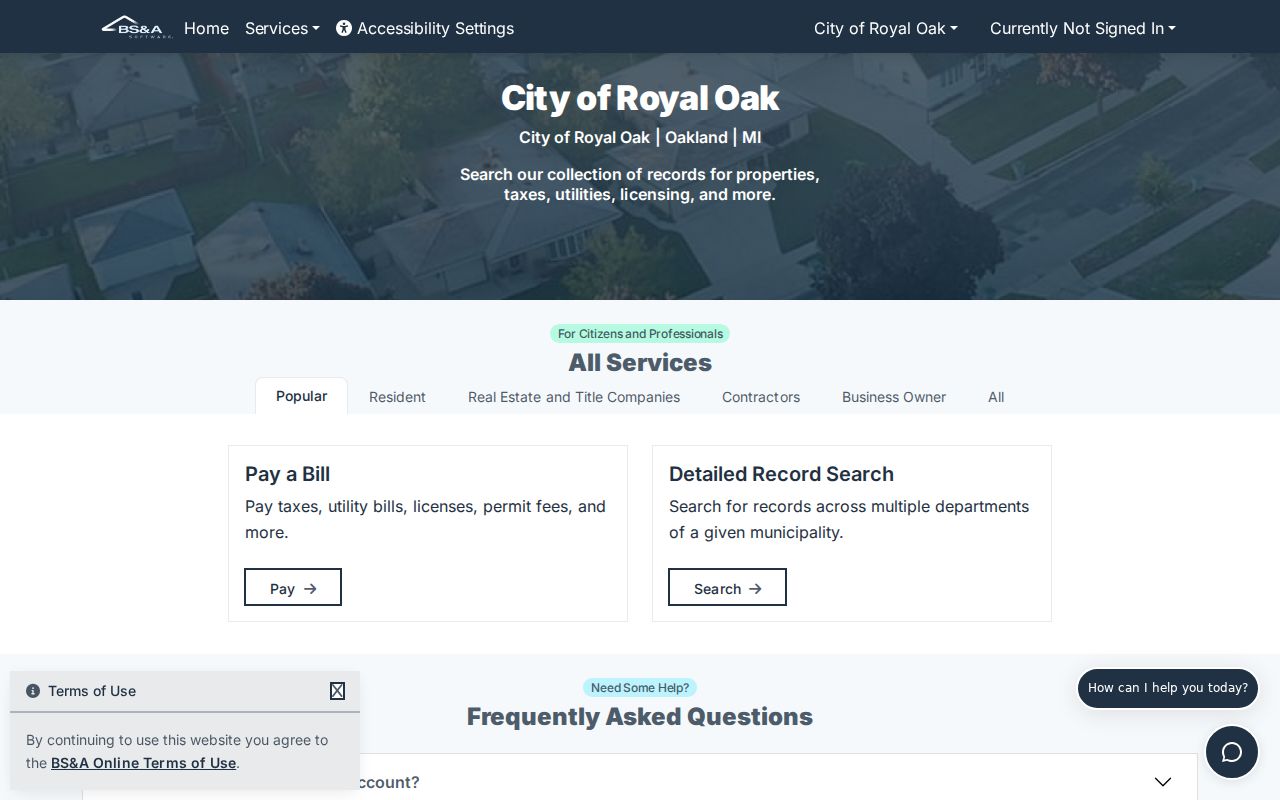
Those three routes let a researcher move between a known street, a recorded owner, and the local parcel identifier without assuming the result lists every resident.
Royal Oak Parcel Map Context
The county adds the map layer that the city assessment search cannot supply. Oakland County Property Gateway accepts a PIN or property address, requires at least five characters, and documents partial address and wildcard examples. It can also take comma-separated PINs. After locating a parcel, map clicking and panning help identify adjacent shapes. Reports and maps use a paid cart and checkout flow, and county notes say coverage and update timing can vary by municipality.
The underlying county parcel service includes situs house number, street, unit, city, ZIP5, owner, mailing details, value, exemption, building, and last-document fields. That distinction matters: situs identifies the parcel’s location; mailing is the correspondence destination. Neither tells who sleeps at an address. A PIN is the stable bridge between the city assessment search, the county map, and recorded land documents.
- Parcel
- A defined piece of land tracked by a local identifier.
- Situs address
- The street location of the parcel itself.
- Mailing address
- The address used for owner or tax correspondence, which can be elsewhere.
- PIN
- The county parcel identification number, also called a parcel ID or Sidwell.
Royal Oak Deed Index Trail
Ownership documents are held by the Oakland County Clerk/Register of Deeds, not by the Royal Oak assessor. The Oakland County Super Index supplies free indexed land-record searching from January 1, 1964 forward. Its simple search accepts a name, address, or PIN. Recording date, Liber/Page, Document Number, filters, sorting, keyword-within-results, and result-size controls help narrow a large result set before an image is needed.
Index data is free, but document images and downloads are paid. Open a specific image only if the legal description, signatures, or full instrument is needed. For an earlier parcel or a complex subdivision, the Tract Index is the fallback. Its computer database covers 1964 to the present, while older manual material reaches into the 1800s. The office asks researchers to bring a Sidwell or PIN when possible and offers in-person or mailed copies, not fax service.
The captured Super Index portal shows the free search path and its image/cart workflow.
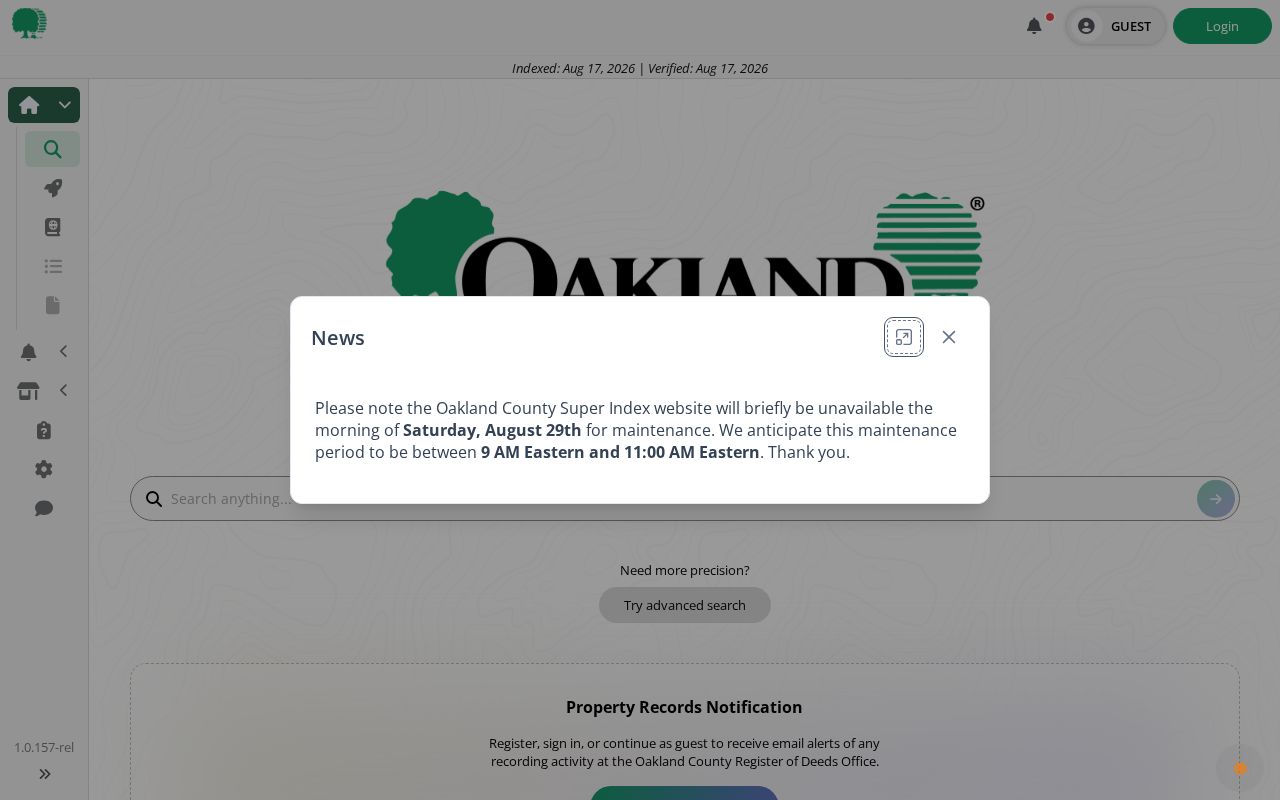
A deed trail records parties to an instrument and transfer dates. It does not establish every person who lived at the property.
Royal Oak Current Directory Sources
Current Royal Oak directory sources each describe a different relationship. The assessment roll ties an owner name to a parcel. The deed index names parties to recorded instruments. Michigan voter records have a controlled individual route and a formal file-request route. Court indexes describe public cases, not a person’s current home. A neighborhood association or Chamber listing can be useful context, but membership is voluntary or limited to an organization. Treat each result as a narrow answer and note its date.
| Source | Who It Lists | Keeper | Access |
|---|---|---|---|
| Royal Oak BS&A | Recorded owner and parcel lead | City Assessing | Public search, with some gated detail |
| Michigan voter channels | Allowed voter status or scoped file data | Secretary of State / Clerk | Individual route or formal request |
| Oakland Super Index | Recorded document parties | Clerk/Register of Deeds | Free index, paid images |
| 44th District Court / MiCOURT | Public case-index lead | Court | Public cases only |
| Royal Oak associations | Organization contacts and limited member services | City-listed groups | Public directory or member access |
When the goal is to verify one named person rather than understand a property, use the more focused Royal Oak resident lookup path and compare name variants, dates, and source limits.
| Official source | Compiled commercial result |
|---|---|
| Names its custodian, record type, and access limit. | Can combine fragments with uneven dates and duplicate names. |
| Can be checked against the original office or collection. | May require its own privacy request when a profile is incorrect. |
| Shows a defined fact, such as a deed party or parcel owner. | Should be treated as an unverified lead, not a conclusion about a person. |
Royal Oak Voter Record Boundaries
Michigan Voter Information is intended for a voter’s own registration, polling, and ballot information. It is not a public household list. A properly scoped Qualified Voter File request can use geography such as county, jurisdiction, district, ward, or precinct and may request allowed names, addresses, year of birth, status, and voting-history fields. The State’s form offers pickup, FTP, and mail, and says voter files are not delivered by email.
Michigan protects driver-license and state-ID numbers, month and day of birth, phone numbers, email, digitized signatures, declined-registration data, and other protected fields. Royal Oak’s fee schedule notes voter information in Excel at $20 per file, but current cost should be confirmed before ordering. A state address can also be protected or old. Use a voter result as one dated lead, not a Royal Oak residents directory that can be republished street by street.
The Michigan voter information hub links the official individual and request channels.
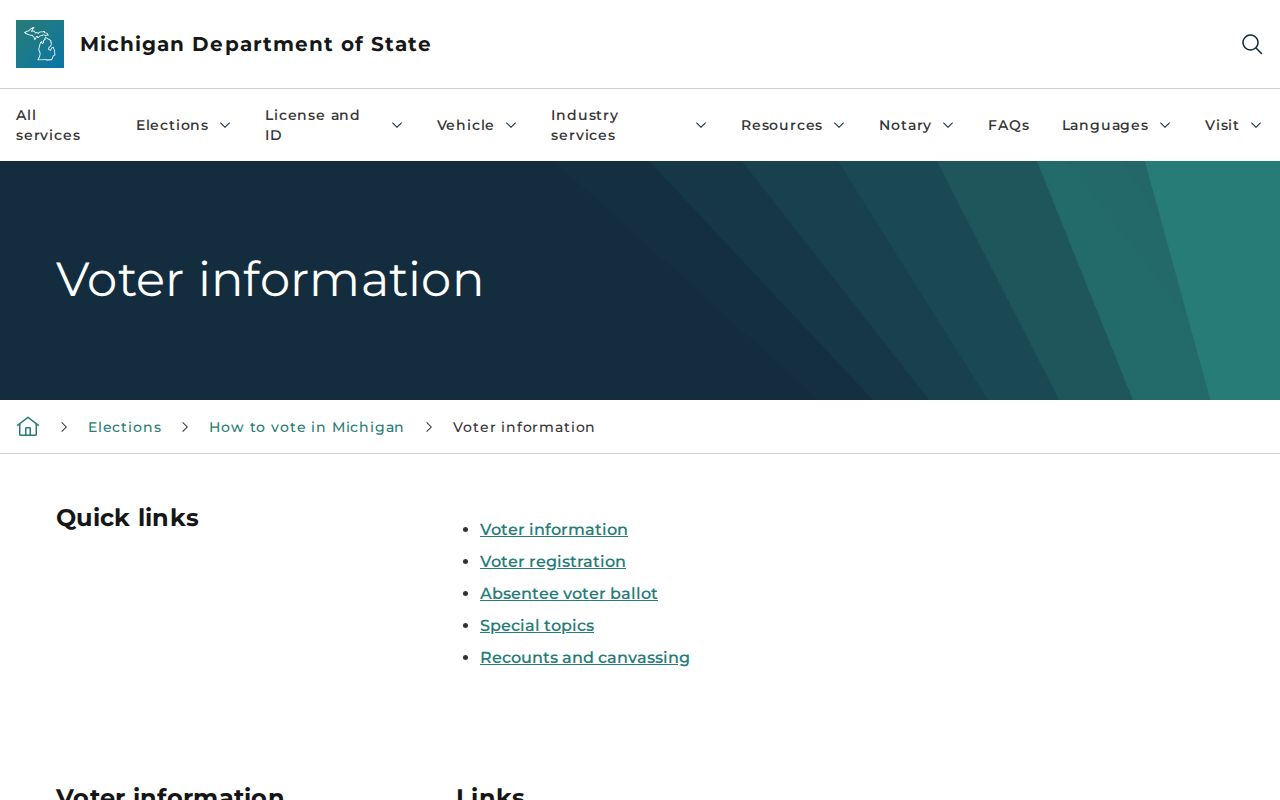
The screen reflects a state election-information service, so its result should be read under the state’s field and privacy limits.
Royal Oak Court Name Checks
A public case search is sometimes useful for separating people with the same name. The 44th District Court serves Royal Oak and Berkley. Its lookup accepts a party name in Last Name First Name order, with one space and no comma, and gives Smi* as a wildcard example. An organization name or docket number can also be used. A warrant status is not available online. For a public case result, compare dates, party role, and the local court before deciding it belongs to the person sought.
MiCOURT is informational rather than an official court record, and display can vary by court, category, and date. Nonpublic, sealed, juvenile, and other protected cases are not available. A zero result is not proof that no case exists. Oakland Circuit and Probate Court Explorer provides a separate county channel for public circuit or estate material. Probate records can connect an estate to heirs or fiduciaries, but confidential filings and attachments remain restricted.
Royal Oak Historical Resident Directories
Royal Oak’s historical resident trail lives on the Local History Room shelf rather than in a single database. Its Polk collection includes specific Royal Oak volumes from 1924 through 1960. South Oakland Bresser cross-index volumes cover 1952 to 1955 and 1964 to 2013. Telephone books, yearbooks, maps, tax rolls, voter registrations, clippings, property abstracts, and the Royal Oak Daily Tribune add dated context. The City’s earliest located local directory is the Royal Oak Village Directory for 1915 to 1916, before the 1921 city incorporation.
A printed name can show that an occupant, subscriber, or business was listed at a time. It cannot by itself prove ownership, a complete household, or a present address. Reserve the library’s Local History Room and ask Adult Reference for items that are not online. The Royal Oak directory book has the collection years, entry-reading method, and household-tracing sequence in full.
Royal Oak Vital Record Routes
Vital records anchor events, not a general list of residents. Oakland County handles eligible local birth, death, and marriage copies and provides a genealogy search for death and marriage records. Michigan Department of Health and Human Services holds statewide birth, death, marriage, and divorce records, with divorce records dating to 1897. Birth records have eligibility limits. Death and marriage copies are generally requestable by anyone who pays the fee, while confidential and court-related exceptions still apply.
For a current order, follow the issuing office’s directions. MDHHS offers online ordering through its authorized provider as well as phone, mail, dropbox, appointment, and regular or expedited processing. Its current guidance says birth records older than 100 years are unrestricted, while MCL 333.2885 uses archival-release language that says 110 years for birth records. The office’s current order rule controls, so confirm it before filing a request. A certificate or index can support identity research, but it does not prove a person’s present residence.
Michigan’s vital-record ordering page explains the record-specific channels and eligibility rules.
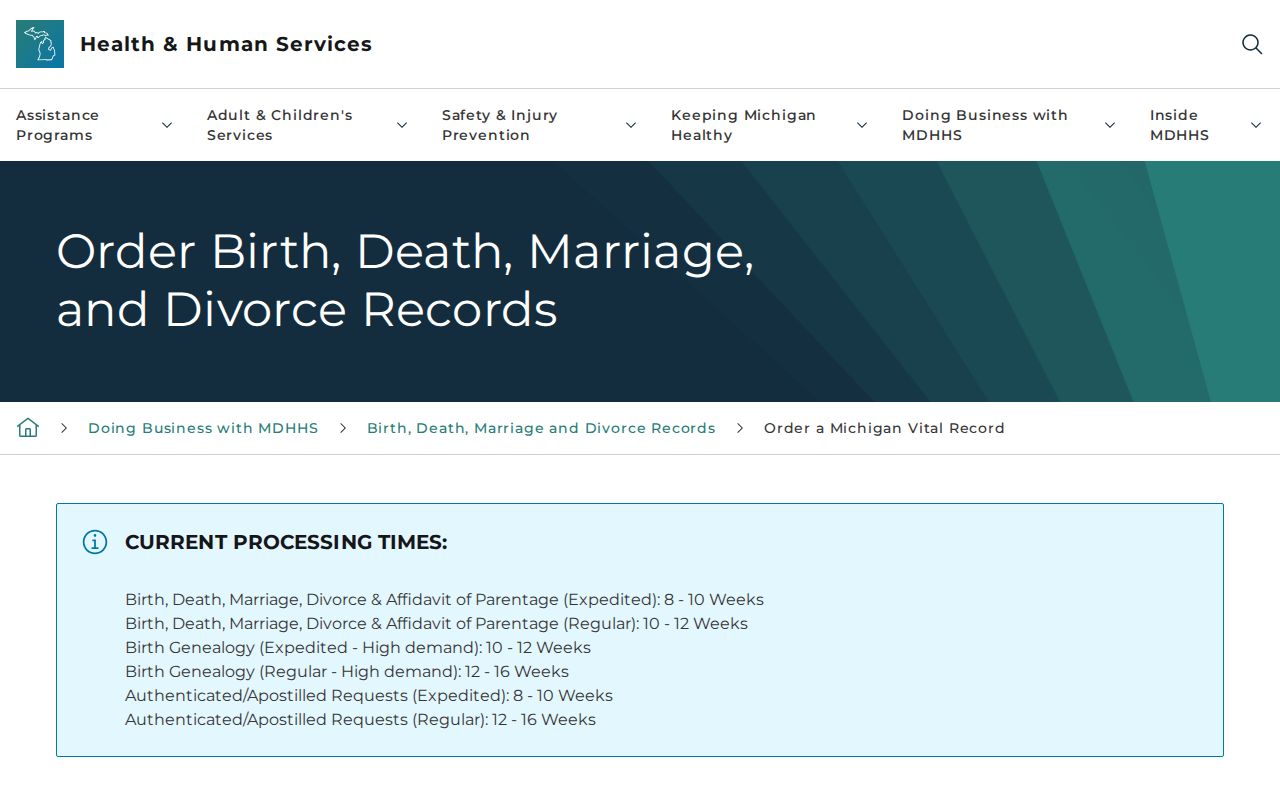
Using the issuing office’s route preserves the distinction between an index lead, a verification, and a certified copy.
Royal Oak Affiliation Records
Some official systems establish a public affiliation rather than an address. Michigan LARA’s MiPLUS can verify a licensee’s name, status, issue and expiration dates, and disciplinary status. Free verification is available, while a certified verification requires an account and costs $15 per license. Michigan’s MiBusiness Registry and Oakland assumed-name records can offer an entity, filing, officer, agent, or co-partnership lead. Those fields can point to a public organizational role, but they should not be treated as evidence of home occupancy.
The Royal Oak Chamber directory is another optional business layer. It has keyword and category searching and represents nearly 500 member businesses, but participation is voluntary. The City’s association directory similarly offers contacts and areas, not a town-wide population roster. In Royal Oak, an organization result is most useful when paired with a dated parcel, directory, probate, or court record that answers a separate question.
The MiPLUS license verification service displays the professional-license search entry point.
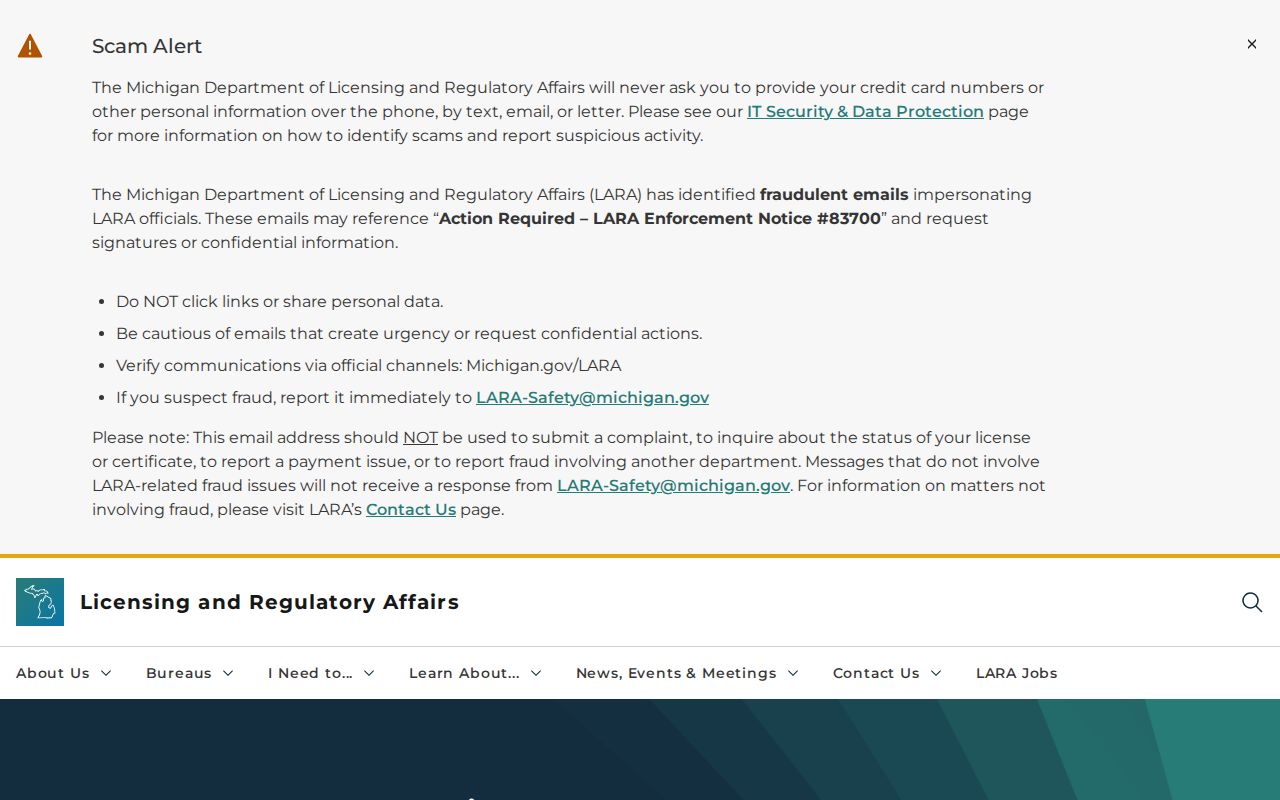
A license record can confirm a regulated status, while an address-based record remains necessary for property or location research.
Royal Oak Record Gaps and Safety
When the online trail ends, use the channel that actually holds the material. The Royal Oak Clerk can route a municipal request. Police, Code Enforcement, and Building records may require a request that names the address, record type, date range, and desired delivery format. Michigan Freedom of Information Act, 1976 PA 442, MCL 15.231–15.246, applies to existing public records and normally calls for a response within five business days, with one possible ten-business-day extension. It does not require an office to create a custom resident list or disclose exempt material.
Michigan Safe at Home participants can use a substitute address, and voter, court, vital, and DMV records have separate nonpublic fields or access limits. Avoid third-party deed solicitations. Oakland County’s free Property Record Notification service alerts a subscriber when a document is recorded and is the proper starting point for a suspicious deed. Confirm a domain and fee with the county before paying for a copy. Public access is a reason to verify with the custodian, not a reason to republish sensitive details.
Note: The strongest Royal Oak residents directory result is often a short, documented trail that names its source, date, and limitation instead of claiming more than the record shows.